
Face Symmetry Test
Measure bilateral landmark alignment across five facial regions and preview Left–Left and Right–Right mirror composites on your device.
Upload a photo
Your photo is analysed on your device. If you send it from your phone, it is encrypted end-to-end and deleted within 10 minutes.
Photo tips for the clearest result
- Face straight into the camera with a neutral expression.
- Pull hair back from your forehead and jawline.
- Use even, front-facing light and remove glasses or hats.
- Keep your whole face centered and filling a good part of the frame.
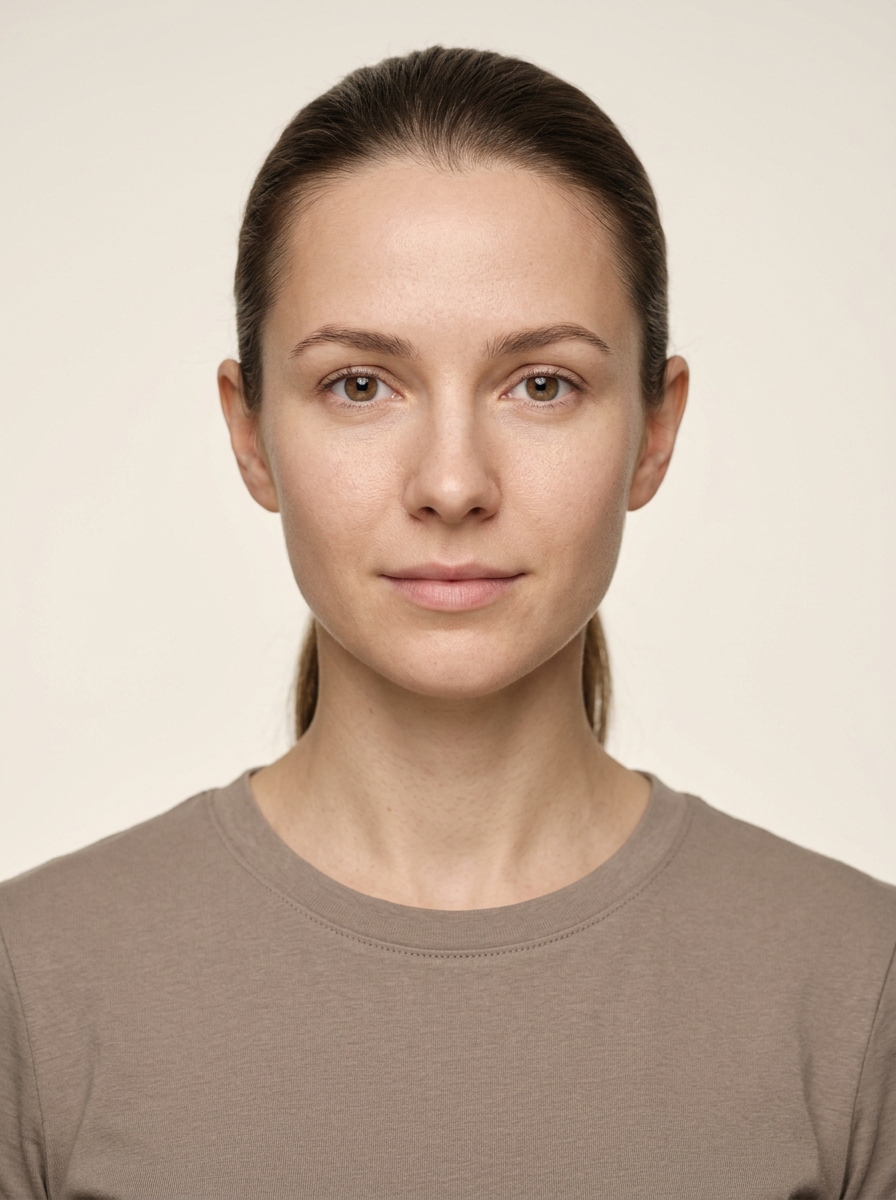
Live output preview
Overall alignment
91 / 100
Bilateral landmark pairs mirrored across 5-point midline
Includes downloadable Left–Left & Right–Right mirror composites
Step-by-step guide
How to Check Your Facial Symmetry
01 · Straight-on photo
Avoid head turn & side light
Upload a neutral frontal portrait or use your camera facing even window light so both halves are lit identically.
02 · Midline fit
5-region bilateral scan
Your browser fits a central midline through forehead, nose bridge, nose base, and chin, then compares 5 paired facial regions.
03 · Mirror composites
Inspect Left–Left & Right–Right
Compare both mirrored composites side by side and download the PNG locally if you want to test hair parting direction.
Reference ranges
Facial Symmetry Alignment Bands
| Alignment Band | Typical Cause | Practical Takeaway |
|---|---|---|
| 90 – 100 | Very close left-right landmark alignment | Center parts and crisp symmetrical eyewear frames sit effortlessly. |
| 80 – 89 | Normal natural human symmetry | Standard range for unedited frontal portraits; both center and side parts work. |
| 70 – 79 | Mild natural asymmetry or slight yaw | A soft off-center or deep side part adds flattering visual balance. |
| Under 70 | Head turn, smile, or uneven shadow | Retake facing straight ahead with a relaxed mouth for a true baseline. |
Methodology & privacy
How the Face Symmetry Test Scores Your Midline
After roll-correcting your photo, our analyzer fits a vertical midline through five central landmarks and mirrors left-side landmarks onto the right side across five regions: eyes, eyebrows, nose, mouth, and jaw.
Scores reflect geometric landmark alignment in a single frame—not a population percentile, medical metric, or measure of attractiveness. Natural asymmetry is universal and gives every face its recognizable character.
Runs 100% locally in your browser via MediaPipe 478-point facial landmarks. Photos and measurements are never uploaded, stored on a server, or used to train AI models. Results are objective geometric style references—never clinical diagnoses or attractiveness ratings.
Read our full 478-landmark methodology & published sources →
Camera distance
Avoid close-up lens distortion
Holding a wide-angle smartphone camera inches from your nose artificially enlarges the center of your face and narrows the temples and ears. Step back to full arm’s length or use a 2× rear lens at eye level for accurate geometry.
Lighting & posture
Face even natural daylight
Harsh overhead shadows or side window light can shift cheek, brow, and jaw boundaries by several millimeters. Keep your chin level, relax your mouth, pull hair off your forehead, and look straight into the lens.
Zero-upload privacy
Processed strictly on device
Unlike cloud apps that upload selfies to remote GPUs, every landmark calculation runs inside WebAssembly in your browser tab. Closing the tab clears image memory immediately—nothing is logged, stored, or shared with third parties.
Deep-dive guides
Related styling & proportion guides
How to Fix Facial Asymmetry: Causes & Practical Fixes
Separate mirror-flip illusions from sleep posture, hair parting, face yoga myths, and everyday visual balance.
Read guide →Facial Harmony Explained: The 5 Core Facial Ratios
See how vertical thirds, horizontal fifths, fWHR, symmetry, and golden ratio work together without beauty scores.
Read guide →FAQ
Facial Symmetry FAQ
How is facial symmetry measured?
We fit a vertical midline through five central landmarks (forehead, nose bridge, nose base, and chin), mirror left-side points across that line, and measure their normalized distance to the matching right-side points across five regions.
Are the score bands (90+, 80–89, 70–79) population percentiles?
No. They are geometric alignment bands for a single photo, not clinical scores or population percentiles. Slight head turn, side lighting, or a subtle smile can lower a reading by 5–10 points.
What are the Left–Left and Right–Right composite faces?
They mirror each half of your face along the detected midline in your browser so you can compare how each side behaves visually. Almost every real face looks noticeably different in both composites.
Does my photo stay private?
Yes. Landmark detection and composite rendering happen 100% locally in your browser.
Is a perfectly 100% symmetrical face normal?
No. Anthropometric studies consistently show that virtually every human face has natural left-right variation in brow arch, eye height, smile pull, and jaw angle. Most natural frontal portraits score in the 80–92 band.
Why does photo lighting change my symmetry score?
Strong side lighting casts shadows that can shift cheek and jaw landmarks slightly, and even a 3–5 degree head turn makes the nearer side appear wider. Face a window straight on for the cleanest midline.
How can I use my symmetry score for hair parting or glasses?
If one brow sits slightly higher or your jaw curves differently on one side, parting your hair toward the higher-arch side or wearing soft asymmetric layers balances visual weight effortlessly.
Why do Left–Left and Right–Right composites look so different?
Because small differences in eye height, cheek fullness, and smile angle get doubled when mirrored across the midline. Even professional models show striking visual differences between their two mirrored halves.
What areas of the face determine symmetry and balance?
Five paired landmark regions drive perceived balance: eye height and width, eyebrow arch height, nose bridge alignment, mouth corner level, and cheekbone-to-jawline contour. Our face symmetry checker scores each region individually.
How is this different from a social media face symmetry filter?
Social media symmetry filters simply flip your live camera image without explaining where differences sit. Our browser-based face symmetry analyzer computes a roll-corrected midline across 478 landmarks, renders side-by-side Left–Left and Right–Right mirror composites, and pairs with our True Mirror Online tool.