
Facial Thirds Test & Fifths Calculator
Check your vertical facial thirds (upper, middle, lower) and horizontal fifths on your device—no upload, no sign-up.
Upload a photo
Your photo is analysed on your device. If you send it from your phone, it is encrypted end-to-end and deleted within 10 minutes.
Photo tips for the clearest result
- Face straight into the camera with a neutral expression.
- Pull hair back from your forehead and jawline.
- Use even, front-facing light and remove glasses or hats.
- Keep your whole face centered and filling a good part of the frame.
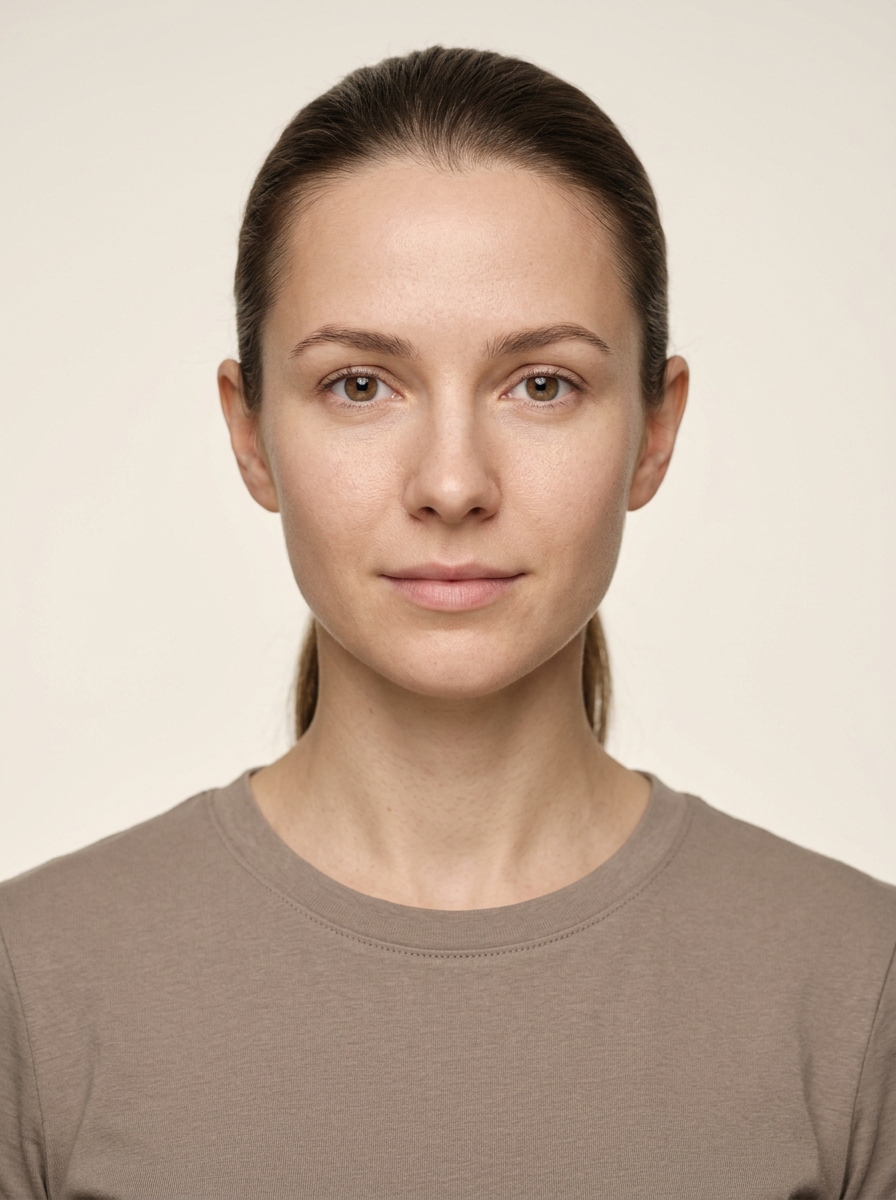
Live output preview
Vertical thirds
32 / 34 / 34%
Upper (forehead) · Middle (brow-nose) · Lower (nose-chin)
Visualizes vertical balance and horizontal eye spacing
Step-by-step guide
How to Use the Facial Thirds Calculator
Follow three quick steps to get an accurate vertical thirds and horizontal fifths breakdown without camera distortion.
Keep hair off your forehead
Pull bangs or loose strands back so the upper forehead boundary, eyebrows, nose base, and chin tip are all clearly visible.
Take a straight-on, eye-level photo
Face the camera squarely with a relaxed expression and neutral chin tilt. Even lighting helps the landmark mesh anchor cleanly.
Read your thirds & fifths chart
Compare your upper, middle, and lower percentages against the classical 33.3% baseline and inspect your five horizontal eye-width segments.
Reference ranges
What the Facial Thirds Calculator Measures
Artists, hairstylists, and eyewear fitters use the Rule of Thirds and Rule of Fifths as visual proportion guides—not pass/fail standards.
| Zone | Landmark Span | Classical Baseline | Practical Styling Note |
|---|---|---|---|
| Upper third | Upper forehead (trichion) to brow line (glabella) | ~33.3% of face height | |
| Middle third | Brow line (glabella) to nose base (subnasale) | ~33.3% of face height | |
| Lower third | Nose base (subnasale) to chin tip (menton) | ~33.3% of face height | |
| Horizontal fifths | Five equal widths across outer temples, both eyes, and intercanthal gap | ~20% each (1 eye width) |
Methodology & privacy
How Vertical Thirds & Horizontal Fifths Are Computed
Our facial thirds calculator rotates detected 478-point MediaPipe landmarks by your inter-ocular roll angle before measuring vertical spans from upper forehead to brow, brow to nose base, and nose base to chin. Because landmark 10 sits slightly below a natural hairline, high foreheads may read a couple of percentage points shorter than tape measurements.
Horizontal fifths divide total bizygomatic face width across five regions—left temple, left eye, inter-eye distance, right eye, and right temple—so you can see how eye spacing relates to overall face width. All computation runs privately in your browser memory with zero server uploads.
Runs 100% locally in your browser via MediaPipe 478-point facial landmarks. Photos and measurements are never uploaded, stored on a server, or used to train AI models. Results are objective geometric style references—never clinical diagnoses or attractiveness ratings.
Read our full 478-landmark methodology & published sources →
Camera distance
Avoid close-up lens distortion
Holding a wide-angle smartphone camera inches from your nose artificially enlarges the center of your face and narrows the temples and ears. Step back to full arm’s length or use a 2× rear lens at eye level for accurate geometry.
Lighting & posture
Face even natural daylight
Harsh overhead shadows or side window light can shift cheek, brow, and jaw boundaries by several millimeters. Keep your chin level, relax your mouth, pull hair off your forehead, and look straight into the lens.
Zero-upload privacy
Processed strictly on device
Unlike cloud apps that upload selfies to remote GPUs, every landmark calculation runs inside WebAssembly in your browser tab. Closing the tab clears image memory immediately—nothing is logged, stored, or shared with third parties.
FAQ
Facial Thirds Calculator FAQ
What are facial thirds and fifths?
Vertical facial thirds divide face height into three zones: upper (hairline to brow), middle (brow to nose base), and lower (nose base to chin), with a classical 33.3% reference each. Horizontal fifths divide face width across five eye-width segments (20% each).
Why does the upper third use the forehead landmark?
MediaPipe’s top mesh landmark (index 10) sits at the upper forehead just below the hairline. Pull bangs and loose hair away from your forehead so the upper boundary stays unobstructed.
What is a normal vertical facial thirds ratio?
Very few faces measure an exact 33.3% / 33.3% / 33.3% split. Most adults naturally fall between 29% and 38% per zone, and mild variation is what gives every face its recognizable character.
How do I use facial thirds for hairstyles or glasses?
If your upper third is longest, curtain bangs, textured fringes, or wispy layers visually shorten the forehead. If your middle third is longest, slightly taller eyeglass frames or mid-cheek waves add balance; if your lower third is longest, crown volume and temple fullness lift visual focus upward.
Can camera angle distort facial thirds calculator results?
Yes. Holding the camera above eye level makes the upper third look larger and the lower third smaller; tilting the chin up exaggerates the lower third. Keep the lens level with your eyes at arm’s length or farther.
Does my photo leave my device?
No. All 478-point landmark detection and proportion math run locally in your browser—nothing is uploaded or stored on any server.